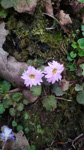
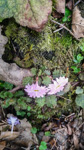
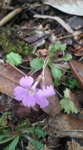
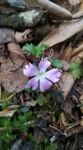
Primula lepcha Dharmit Lepcha, Harsh Singh & A. Chettri Phytotaxa 732 (1): 84. 2025
Section Petiolares
Type specimen: Dharmitt Lepcha 794 resdies at SU (holotype), BHSC (isotype).
Epithet: Named for The collectors Rhomoo Lepcha and Ribu Lepcha belonging to the Lepcha community of Sikkim.
Distribution: N Sikkim, India.
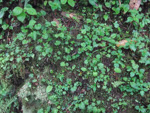
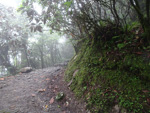
In 1917, Craib undertook a complete revision of Primula section Petiolares resulting in the new description of several species, including P. scapigera. In the discussion paper "Primula of the Petiolares-Sonchifolia Section", Craib noted under P. scapigera that the herbarium sheets mentioned under that species included varieties or microforms but the material on hand was not sufficient for further study. In particular though, he noted "On the descent from Jongri, Watt collected in the pine forest at 10,000 ft. (Watt, 5615, in Herb. Edin. (E01080370) et Kew) a scapigerous plant very different from the type in being much weaker and in having thinner, more deeply cut leaves and much smaller fruit." This is now described as the new species P. lepcha and compared to P. bhutanica (sometimes considered a synonym for P. whitei), P. whitei and P. bracteosa, but unfortunely not P. scapigera. The type was collected in the Naga Forest of North Sikkim. It has been frequently encounterd near Tshoka, below Dzongri. Field observations by tourists show that occasionally this species can produce a new plant from the apex of the scape, similar to P. bracteosa.
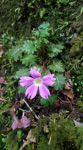
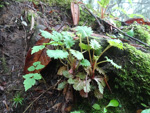
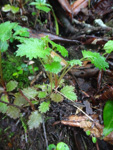
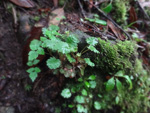
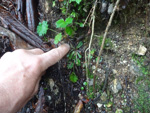
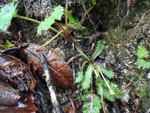
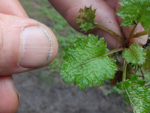
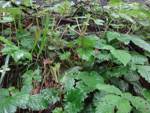
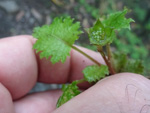
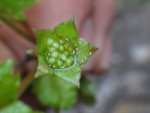
P. lepcha has dimorphic leaves, inner leaves oblong, broadly winged and petiole insignificant, and outer leaves deltoid, petiole distinct to 2cm. Scape to 1.5cm, umbel of 2-4 exannulate flowers or solitary. Corolla mauve to purple-blue with a yellow eye and white surround, pubescent at the mouth, lobes obovate or suborbicular, apex irregularly notched with 2 teeth or more. Homostylous and heterostylous forms are reported.